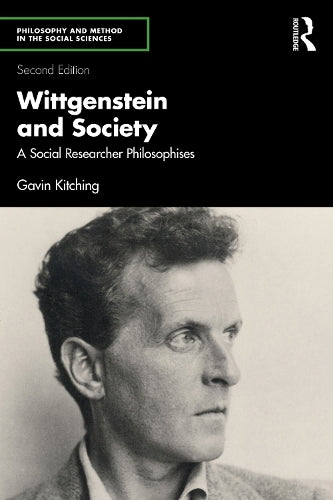
Wittgenstein and Society
Building on the success of Wittgenstein and Society: Essays in Conceptual Puzzlement (2003), this freshly conceptualised second edition offers a unique perspective on Wittgenstein’s later philosophy by examining its implications through the lens of empirical social research.
Gavin Kitching, an experienced social researcher, explores how the study of language use in Kenya, Russia, and the North-East of England deepens our understanding of Wittgenstein’s famous assertion that “the meaning of a word is its use in the language.” By reversing the traditional approach, the book highlights how social research can inform philosophical ideas, rather than the other way around. The book is divided into three parts. Part One introduces Wittgenstein’s philosophy and critiques postmodernist thought. Part Two delves into Kitching’s empirical research, focusing on key concepts such as ‘class,’ ‘peasant,’ ‘production cost,’ and ‘football,’ and their philosophical implications. Part Three reflects on the broader significance of Wittgenstein’s ideas, emphasizing the richness and complexity of ordinary language use.
Utilising a unique interdisciplinary approach, which bridges philosophy and social science in a way that challenges conventional academic boundaries, it will be an essential resource for scholars, advanced undergraduate students and postgraduate students in philosophy, sociology, social anthropology, and history, with interests in Wittgenstein’s philosophy and its practical applications in social research.
Original: $51.99
-65%$51.99
$18.20Wittgenstein and Society
Building on the success of Wittgenstein and Society: Essays in Conceptual Puzzlement (2003), this freshly conceptualised second edition offers a unique perspective on Wittgenstein’s later philosophy by examining its implications through the lens of empirical social research.
Gavin Kitching, an experienced social researcher, explores how the study of language use in Kenya, Russia, and the North-East of England deepens our understanding of Wittgenstein’s famous assertion that “the meaning of a word is its use in the language.” By reversing the traditional approach, the book highlights how social research can inform philosophical ideas, rather than the other way around. The book is divided into three parts. Part One introduces Wittgenstein’s philosophy and critiques postmodernist thought. Part Two delves into Kitching’s empirical research, focusing on key concepts such as ‘class,’ ‘peasant,’ ‘production cost,’ and ‘football,’ and their philosophical implications. Part Three reflects on the broader significance of Wittgenstein’s ideas, emphasizing the richness and complexity of ordinary language use.
Utilising a unique interdisciplinary approach, which bridges philosophy and social science in a way that challenges conventional academic boundaries, it will be an essential resource for scholars, advanced undergraduate students and postgraduate students in philosophy, sociology, social anthropology, and history, with interests in Wittgenstein’s philosophy and its practical applications in social research.
Product Information
Product Information
Shipping & Returns
Shipping & Returns
Description
Building on the success of Wittgenstein and Society: Essays in Conceptual Puzzlement (2003), this freshly conceptualised second edition offers a unique perspective on Wittgenstein’s later philosophy by examining its implications through the lens of empirical social research.
Gavin Kitching, an experienced social researcher, explores how the study of language use in Kenya, Russia, and the North-East of England deepens our understanding of Wittgenstein’s famous assertion that “the meaning of a word is its use in the language.” By reversing the traditional approach, the book highlights how social research can inform philosophical ideas, rather than the other way around. The book is divided into three parts. Part One introduces Wittgenstein’s philosophy and critiques postmodernist thought. Part Two delves into Kitching’s empirical research, focusing on key concepts such as ‘class,’ ‘peasant,’ ‘production cost,’ and ‘football,’ and their philosophical implications. Part Three reflects on the broader significance of Wittgenstein’s ideas, emphasizing the richness and complexity of ordinary language use.
Utilising a unique interdisciplinary approach, which bridges philosophy and social science in a way that challenges conventional academic boundaries, it will be an essential resource for scholars, advanced undergraduate students and postgraduate students in philosophy, sociology, social anthropology, and history, with interests in Wittgenstein’s philosophy and its practical applications in social research.