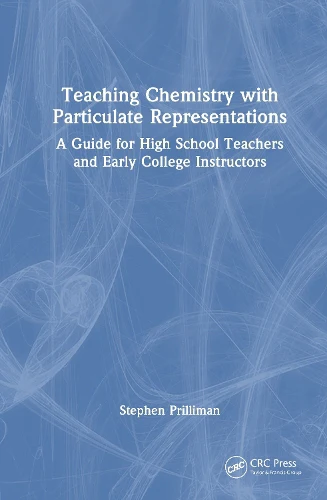
Teaching Chemistry with Particulate Representations
Understanding chemistry at the level of atoms, ions and molecules – the particulate level – is crucial for student success. This book provides background and tested examples for teaching students to represent chemistry at the particulate level for success in high school, Advanced PlacementTM and introductory college chemistry.
Chemical education research has demonstrated that students often fail to develop a particulate-level understanding from standard chemistry coursework, leaving them frustrated and open to common misconceptions. That research, however, has been shared mainly in books written for academics. This book, aimed at teachers and instructors, takes the findings from the research and presents them in a straightforward way focused on practical applications in the classroom. Topics covered include nature of matter, reactions, stoichiometry, kinetics, and thermodynamics.
Introductory chapters briefly survey the research on particulate representations and consider practical issues for implementing them in the classroom. Ten unit chapters show how particulate representations can be used throughout the chemistry curriculum with examples of diagrams, physical models, simulations and classroom activities to use with students.
Teaching Chemistry with Particulate Representations
Understanding chemistry at the level of atoms, ions and molecules – the particulate level – is crucial for student success. This book provides background and tested examples for teaching students to represent chemistry at the particulate level for success in high school, Advanced PlacementTM and introductory college chemistry.
Chemical education research has demonstrated that students often fail to develop a particulate-level understanding from standard chemistry coursework, leaving them frustrated and open to common misconceptions. That research, however, has been shared mainly in books written for academics. This book, aimed at teachers and instructors, takes the findings from the research and presents them in a straightforward way focused on practical applications in the classroom. Topics covered include nature of matter, reactions, stoichiometry, kinetics, and thermodynamics.
Introductory chapters briefly survey the research on particulate representations and consider practical issues for implementing them in the classroom. Ten unit chapters show how particulate representations can be used throughout the chemistry curriculum with examples of diagrams, physical models, simulations and classroom activities to use with students.
Product Information
Product Information
Shipping & Returns
Shipping & Returns
Description
Understanding chemistry at the level of atoms, ions and molecules – the particulate level – is crucial for student success. This book provides background and tested examples for teaching students to represent chemistry at the particulate level for success in high school, Advanced PlacementTM and introductory college chemistry.
Chemical education research has demonstrated that students often fail to develop a particulate-level understanding from standard chemistry coursework, leaving them frustrated and open to common misconceptions. That research, however, has been shared mainly in books written for academics. This book, aimed at teachers and instructors, takes the findings from the research and presents them in a straightforward way focused on practical applications in the classroom. Topics covered include nature of matter, reactions, stoichiometry, kinetics, and thermodynamics.
Introductory chapters briefly survey the research on particulate representations and consider practical issues for implementing them in the classroom. Ten unit chapters show how particulate representations can be used throughout the chemistry curriculum with examples of diagrams, physical models, simulations and classroom activities to use with students.