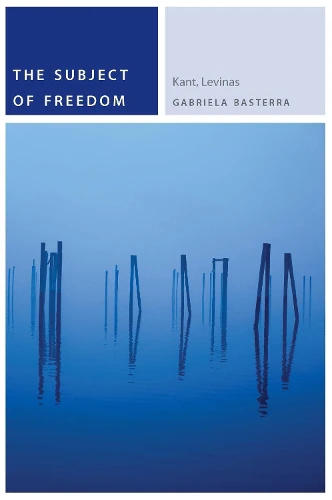
Subject of Freedom
Is freedom our most essential belonging, the intimate source of self-mastery, an inalienable right? Or is it something foreign, an other that constitutes subjectivity, a challenge to our notion of autonomy? To Basterra, the subjectivity we call free embodies a relationship with an irreducible otherness that at once exceeds it and animates its core.
Tracing Kant's concept of freedom from the Critique of Pure Reason to his practical works, Basterra elaborates his most revolutionary insights by setting them in dialogue with Levinas's Otherwise than Being. Levinas's text, she argues, offers a deep critique of Kant that follows the impulse of his thinking to its most promising consequences. The complex concepts of freedom, autonomy, and subjectivity that emerge from this dialogue have the potential to energize today's ethical and political thinking.
Original: $91.99
-65%$91.99
$32.20Subject of Freedom
Is freedom our most essential belonging, the intimate source of self-mastery, an inalienable right? Or is it something foreign, an other that constitutes subjectivity, a challenge to our notion of autonomy? To Basterra, the subjectivity we call free embodies a relationship with an irreducible otherness that at once exceeds it and animates its core.
Tracing Kant's concept of freedom from the Critique of Pure Reason to his practical works, Basterra elaborates his most revolutionary insights by setting them in dialogue with Levinas's Otherwise than Being. Levinas's text, she argues, offers a deep critique of Kant that follows the impulse of his thinking to its most promising consequences. The complex concepts of freedom, autonomy, and subjectivity that emerge from this dialogue have the potential to energize today's ethical and political thinking.
Product Information
Product Information
Shipping & Returns
Shipping & Returns
Description
Is freedom our most essential belonging, the intimate source of self-mastery, an inalienable right? Or is it something foreign, an other that constitutes subjectivity, a challenge to our notion of autonomy? To Basterra, the subjectivity we call free embodies a relationship with an irreducible otherness that at once exceeds it and animates its core.
Tracing Kant's concept of freedom from the Critique of Pure Reason to his practical works, Basterra elaborates his most revolutionary insights by setting them in dialogue with Levinas's Otherwise than Being. Levinas's text, she argues, offers a deep critique of Kant that follows the impulse of his thinking to its most promising consequences. The complex concepts of freedom, autonomy, and subjectivity that emerge from this dialogue have the potential to energize today's ethical and political thinking.