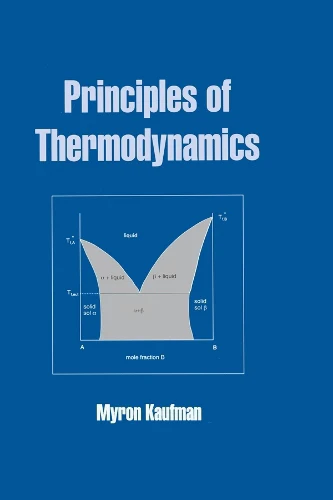
Principles of Thermodynamics
Ideal for one- or two-semester courses that assume elementary knowledge of calculus, This text presents the fundamental concepts of thermodynamics and applies these to problems dealing with properties of materials, phase transformations, chemical reactions, solutions and surfaces. The author utilizes principles of statistical mechanics to illustrate key concepts from a microscopic perspective, as well as develop equations of kinetic theory. The book provides end-of-chapter question and problem sets, some using Mathcad™ and Mathematica™; a useful glossary containing important symbols, definitions, and units; and appendices covering multivariable calculus and valuable numerical methods.
$28.35
Original: $80.99
-65%Principles of Thermodynamics—
$80.99
$28.35Principles of Thermodynamics
Ideal for one- or two-semester courses that assume elementary knowledge of calculus, This text presents the fundamental concepts of thermodynamics and applies these to problems dealing with properties of materials, phase transformations, chemical reactions, solutions and surfaces. The author utilizes principles of statistical mechanics to illustrate key concepts from a microscopic perspective, as well as develop equations of kinetic theory. The book provides end-of-chapter question and problem sets, some using Mathcad™ and Mathematica™; a useful glossary containing important symbols, definitions, and units; and appendices covering multivariable calculus and valuable numerical methods.
Product Information
Product Information
Shipping & Returns
Shipping & Returns
Description
Ideal for one- or two-semester courses that assume elementary knowledge of calculus, This text presents the fundamental concepts of thermodynamics and applies these to problems dealing with properties of materials, phase transformations, chemical reactions, solutions and surfaces. The author utilizes principles of statistical mechanics to illustrate key concepts from a microscopic perspective, as well as develop equations of kinetic theory. The book provides end-of-chapter question and problem sets, some using Mathcad™ and Mathematica™; a useful glossary containing important symbols, definitions, and units; and appendices covering multivariable calculus and valuable numerical methods.