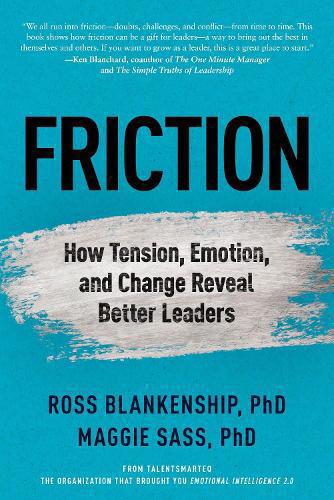
Friction
Emotions are messy. Life is full of friction. Here’s what to do about it.
You’ve felt it — the meeting that goes sideways after one wrong word, the feedback that lands wrong no matter how carefully you planned it, the relationship that keeps getting stuck in the same loop. You’ve felt it inside yourself too: the moment you react before you mean to, the pressure that makes everything harder than it should be, the Sunday evening dread that has nothing to do with the actual work.
That tension has a name. It’s friction — and most of us have never been taught what to do with it.
In Friction, leadership researchers and organizational psychologists Maggie Sass and Ross Blankenship make the case that friction isn’t random, it isn’t weakness, and it isn’t just “bad communication.” It’s a predictable force that shows up in three distinct places — inside you, between people, and in the systems and structures around you — and it’s quietly shaping everything from your own performance to your team’s culture.
Drawing on findings from their National Emotions Survey of U.S. working adults, Sass and Blankenship introduce a practical framework for understanding how emotional tension actually works at work, and what you can do to reduce the costly kind while using productive friction to sharpen thinking, deepen trust, and improve outcomes.
The heart of the book is 45 experiments, organized across all three types of friction, that you can put to work immediately. Strategies like “Breathe Before the Story,” “Set the Temperature with Your First Sentence,” “Listen for What’s at Stake,” and “Premium Strategy, Regular Fuel” give you concrete experiments to try in the moments when friction shows up and you need to respond on purpose rather than on instinct.
Friction will help you:
Spot the warning signs of escalating tension before it becomes a problem
Handle pressure without passing it on to your team
Have the hard conversations you’ve been avoiding
Build the kind of trust that makes your team resilient, not just compliant
Recognize when the system itself is creating friction, and what to do about it
Lead with more intention in conditions that feel faster and less forgiving than they used to
Friction is for anyone who has ever been caught off guard by their own reaction, or someone else’s. It’s for the newly promoted manager who’s discovering that the job is 80% emotional and no one ever told them. It’s for the seasoned leader who’s tired of advice that assumes they can be a robot or a saint. It’s for the HR partner, the executive coach, the L&D director, and the facilitator who can feel a room’s energy shift but need new language to help them navigate changing dynamics. And it’s for anyone who has ever thought: Where is the user’s manual for this mess?
Most leadership books ask you to choose: work on yourself, fix your relationships, or change your culture. Friction shows you why all three are connected by emotion and gives you the tools to work on all of them at once, backed by a companion website and downloadable worksheets.
The goal isn’t to eliminate friction. The goal is to lead through it, better.
Friction
Emotions are messy. Life is full of friction. Here’s what to do about it.
You’ve felt it — the meeting that goes sideways after one wrong word, the feedback that lands wrong no matter how carefully you planned it, the relationship that keeps getting stuck in the same loop. You’ve felt it inside yourself too: the moment you react before you mean to, the pressure that makes everything harder than it should be, the Sunday evening dread that has nothing to do with the actual work.
That tension has a name. It’s friction — and most of us have never been taught what to do with it.
In Friction, leadership researchers and organizational psychologists Maggie Sass and Ross Blankenship make the case that friction isn’t random, it isn’t weakness, and it isn’t just “bad communication.” It’s a predictable force that shows up in three distinct places — inside you, between people, and in the systems and structures around you — and it’s quietly shaping everything from your own performance to your team’s culture.
Drawing on findings from their National Emotions Survey of U.S. working adults, Sass and Blankenship introduce a practical framework for understanding how emotional tension actually works at work, and what you can do to reduce the costly kind while using productive friction to sharpen thinking, deepen trust, and improve outcomes.
The heart of the book is 45 experiments, organized across all three types of friction, that you can put to work immediately. Strategies like “Breathe Before the Story,” “Set the Temperature with Your First Sentence,” “Listen for What’s at Stake,” and “Premium Strategy, Regular Fuel” give you concrete experiments to try in the moments when friction shows up and you need to respond on purpose rather than on instinct.
Friction will help you:
Spot the warning signs of escalating tension before it becomes a problem
Handle pressure without passing it on to your team
Have the hard conversations you’ve been avoiding
Build the kind of trust that makes your team resilient, not just compliant
Recognize when the system itself is creating friction, and what to do about it
Lead with more intention in conditions that feel faster and less forgiving than they used to
Friction is for anyone who has ever been caught off guard by their own reaction, or someone else’s. It’s for the newly promoted manager who’s discovering that the job is 80% emotional and no one ever told them. It’s for the seasoned leader who’s tired of advice that assumes they can be a robot or a saint. It’s for the HR partner, the executive coach, the L&D director, and the facilitator who can feel a room’s energy shift but need new language to help them navigate changing dynamics. And it’s for anyone who has ever thought: Where is the user’s manual for this mess?
Most leadership books ask you to choose: work on yourself, fix your relationships, or change your culture. Friction shows you why all three are connected by emotion and gives you the tools to work on all of them at once, backed by a companion website and downloadable worksheets.
The goal isn’t to eliminate friction. The goal is to lead through it, better.
Product Information
Product Information
Shipping & Returns
Shipping & Returns
Description
Emotions are messy. Life is full of friction. Here’s what to do about it.
You’ve felt it — the meeting that goes sideways after one wrong word, the feedback that lands wrong no matter how carefully you planned it, the relationship that keeps getting stuck in the same loop. You’ve felt it inside yourself too: the moment you react before you mean to, the pressure that makes everything harder than it should be, the Sunday evening dread that has nothing to do with the actual work.
That tension has a name. It’s friction — and most of us have never been taught what to do with it.
In Friction, leadership researchers and organizational psychologists Maggie Sass and Ross Blankenship make the case that friction isn’t random, it isn’t weakness, and it isn’t just “bad communication.” It’s a predictable force that shows up in three distinct places — inside you, between people, and in the systems and structures around you — and it’s quietly shaping everything from your own performance to your team’s culture.
Drawing on findings from their National Emotions Survey of U.S. working adults, Sass and Blankenship introduce a practical framework for understanding how emotional tension actually works at work, and what you can do to reduce the costly kind while using productive friction to sharpen thinking, deepen trust, and improve outcomes.
The heart of the book is 45 experiments, organized across all three types of friction, that you can put to work immediately. Strategies like “Breathe Before the Story,” “Set the Temperature with Your First Sentence,” “Listen for What’s at Stake,” and “Premium Strategy, Regular Fuel” give you concrete experiments to try in the moments when friction shows up and you need to respond on purpose rather than on instinct.
Friction will help you:
Spot the warning signs of escalating tension before it becomes a problem
Handle pressure without passing it on to your team
Have the hard conversations you’ve been avoiding
Build the kind of trust that makes your team resilient, not just compliant
Recognize when the system itself is creating friction, and what to do about it
Lead with more intention in conditions that feel faster and less forgiving than they used to
Friction is for anyone who has ever been caught off guard by their own reaction, or someone else’s. It’s for the newly promoted manager who’s discovering that the job is 80% emotional and no one ever told them. It’s for the seasoned leader who’s tired of advice that assumes they can be a robot or a saint. It’s for the HR partner, the executive coach, the L&D director, and the facilitator who can feel a room’s energy shift but need new language to help them navigate changing dynamics. And it’s for anyone who has ever thought: Where is the user’s manual for this mess?
Most leadership books ask you to choose: work on yourself, fix your relationships, or change your culture. Friction shows you why all three are connected by emotion and gives you the tools to work on all of them at once, backed by a companion website and downloadable worksheets.
The goal isn’t to eliminate friction. The goal is to lead through it, better.


