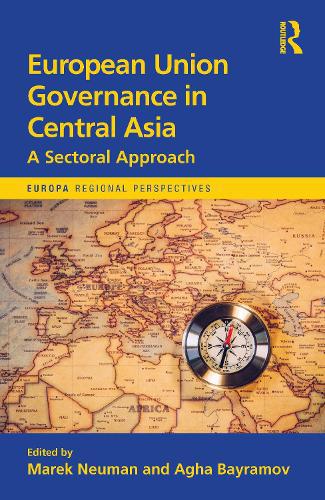
European Union Governance in Central Asia
The edited volume attempts to critically approach EU-Central Asian relations, asking whether – when adopting a more sectoral governance approach – the EU’s transformative power vis-à-vis the region is greater than initially argued and if so, under what conditions it flourishes most. It assesses whether, through adopting a sectoral approach to the area of, development, infrastructure, water management, security, climate change, energy, trade, health, education, or any other element defining EU-Central Asian relations, the European Union is able to (co-)shape this geopolitically strategic region. If so, what drives the EU’s ability to do so; if not, what mitigates its (potential) influence? This book contributes to the scholarship on the EU’s external governance both empirically and theoretically.
$19.95
Original: $56.99
-65%European Union Governance in Central Asia—
$56.99
$19.95European Union Governance in Central Asia
The edited volume attempts to critically approach EU-Central Asian relations, asking whether – when adopting a more sectoral governance approach – the EU’s transformative power vis-à-vis the region is greater than initially argued and if so, under what conditions it flourishes most. It assesses whether, through adopting a sectoral approach to the area of, development, infrastructure, water management, security, climate change, energy, trade, health, education, or any other element defining EU-Central Asian relations, the European Union is able to (co-)shape this geopolitically strategic region. If so, what drives the EU’s ability to do so; if not, what mitigates its (potential) influence? This book contributes to the scholarship on the EU’s external governance both empirically and theoretically.
Product Information
Product Information
Shipping & Returns
Shipping & Returns
Description
The edited volume attempts to critically approach EU-Central Asian relations, asking whether – when adopting a more sectoral governance approach – the EU’s transformative power vis-à-vis the region is greater than initially argued and if so, under what conditions it flourishes most. It assesses whether, through adopting a sectoral approach to the area of, development, infrastructure, water management, security, climate change, energy, trade, health, education, or any other element defining EU-Central Asian relations, the European Union is able to (co-)shape this geopolitically strategic region. If so, what drives the EU’s ability to do so; if not, what mitigates its (potential) influence? This book contributes to the scholarship on the EU’s external governance both empirically and theoretically.


