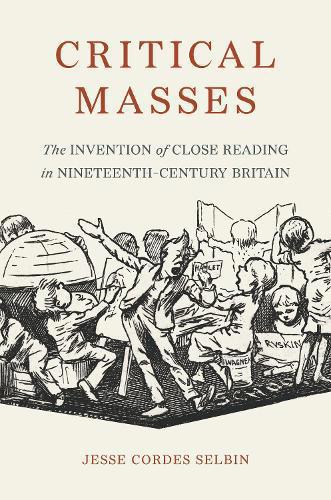
Critical Masses
How close reading developed as an essential tool of critical thinking and democratic citizenship
For the past century, close reading has been seen as a specialized academic enterprise: the invention of professional scholars and critics. Yet in nineteenth-century Britain, the technique was widely framed as an instrument of the masses, a vehicle of collective uplift, and a vital facilitator of what we now call “critical thinking.” In Critical Masses, Jesse Cordes Selbin unearths the Victorian prehistory of close reading, showing how its primary practitioners operated outside academic institutions and cast their work as crucial to democratic engagement among an increasingly literate and enfranchised populace.
Cordes Selbin traces the tradition of the “Popular Critics”: cultural critics, educators, journalists, and novelists who promoted close reading as a tool of critical analysis among popular audiences, particularly workers and women. Popular Criticism, she demonstrates, anticipated the later academic approaches of Practical Criticism and New Criticism. She chronicles the efforts of working-class editor John Cassell to promote close reading to laborers and solicit their contributions, and John Ruskin’s late-career theories of textual interpretation. Cordes Selbin argues that Charlotte Brontë, Elizabeth Gaskell, and George Eliot expanded the mission of Popular Criticism by crafting novels to elicit close reading, building immersive storyworlds and then inviting readers to analyze both themselves and their world.
With Critical Masses, Cordes Selbin offers a new perspective on contemporary “method wars,” recovering an early conception of criticism as dialectical practice. She also finds in Victorian ideals of civic engagement a precedent for current political anxieties about democratic decline.
Original: $96.99
-65%$96.99
$33.95Critical Masses
How close reading developed as an essential tool of critical thinking and democratic citizenship
For the past century, close reading has been seen as a specialized academic enterprise: the invention of professional scholars and critics. Yet in nineteenth-century Britain, the technique was widely framed as an instrument of the masses, a vehicle of collective uplift, and a vital facilitator of what we now call “critical thinking.” In Critical Masses, Jesse Cordes Selbin unearths the Victorian prehistory of close reading, showing how its primary practitioners operated outside academic institutions and cast their work as crucial to democratic engagement among an increasingly literate and enfranchised populace.
Cordes Selbin traces the tradition of the “Popular Critics”: cultural critics, educators, journalists, and novelists who promoted close reading as a tool of critical analysis among popular audiences, particularly workers and women. Popular Criticism, she demonstrates, anticipated the later academic approaches of Practical Criticism and New Criticism. She chronicles the efforts of working-class editor John Cassell to promote close reading to laborers and solicit their contributions, and John Ruskin’s late-career theories of textual interpretation. Cordes Selbin argues that Charlotte Brontë, Elizabeth Gaskell, and George Eliot expanded the mission of Popular Criticism by crafting novels to elicit close reading, building immersive storyworlds and then inviting readers to analyze both themselves and their world.
With Critical Masses, Cordes Selbin offers a new perspective on contemporary “method wars,” recovering an early conception of criticism as dialectical practice. She also finds in Victorian ideals of civic engagement a precedent for current political anxieties about democratic decline.
Product Information
Product Information
Shipping & Returns
Shipping & Returns
Description
How close reading developed as an essential tool of critical thinking and democratic citizenship
For the past century, close reading has been seen as a specialized academic enterprise: the invention of professional scholars and critics. Yet in nineteenth-century Britain, the technique was widely framed as an instrument of the masses, a vehicle of collective uplift, and a vital facilitator of what we now call “critical thinking.” In Critical Masses, Jesse Cordes Selbin unearths the Victorian prehistory of close reading, showing how its primary practitioners operated outside academic institutions and cast their work as crucial to democratic engagement among an increasingly literate and enfranchised populace.
Cordes Selbin traces the tradition of the “Popular Critics”: cultural critics, educators, journalists, and novelists who promoted close reading as a tool of critical analysis among popular audiences, particularly workers and women. Popular Criticism, she demonstrates, anticipated the later academic approaches of Practical Criticism and New Criticism. She chronicles the efforts of working-class editor John Cassell to promote close reading to laborers and solicit their contributions, and John Ruskin’s late-career theories of textual interpretation. Cordes Selbin argues that Charlotte Brontë, Elizabeth Gaskell, and George Eliot expanded the mission of Popular Criticism by crafting novels to elicit close reading, building immersive storyworlds and then inviting readers to analyze both themselves and their world.
With Critical Masses, Cordes Selbin offers a new perspective on contemporary “method wars,” recovering an early conception of criticism as dialectical practice. She also finds in Victorian ideals of civic engagement a precedent for current political anxieties about democratic decline.


