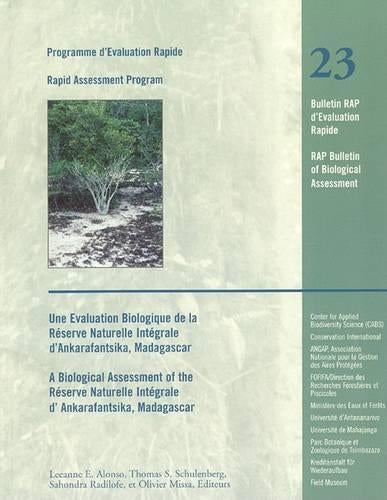
Biological Assessment of the Reserve Naturelle Integrale of d'Ankarafantsika, Madagascar
Over the past half century, slash-and-burn rice farming on Madagascar has slowly expanded from the coastal lowlands into the dense tropical forests of the island's central plateau - many of which are officially protected reserves. This rapid assessment focuses on the Reserve Naturelle Integrale of d'Ankarafantsika, in the northern portion of the island. The area is filled with diverse endemic species but is increasingly threatened by local agricultural methods, and this assessment is critical to the process of evaluating risks and developing sound conservation policies for the future.
$19.99
Biological Assessment of the Reserve Naturelle Integrale of d'Ankarafantsika, Madagascar—
$19.99
Biological Assessment of the Reserve Naturelle Integrale of d'Ankarafantsika, Madagascar
Over the past half century, slash-and-burn rice farming on Madagascar has slowly expanded from the coastal lowlands into the dense tropical forests of the island's central plateau - many of which are officially protected reserves. This rapid assessment focuses on the Reserve Naturelle Integrale of d'Ankarafantsika, in the northern portion of the island. The area is filled with diverse endemic species but is increasingly threatened by local agricultural methods, and this assessment is critical to the process of evaluating risks and developing sound conservation policies for the future.
Product Information
Product Information
Shipping & Returns
Shipping & Returns
Description
Over the past half century, slash-and-burn rice farming on Madagascar has slowly expanded from the coastal lowlands into the dense tropical forests of the island's central plateau - many of which are officially protected reserves. This rapid assessment focuses on the Reserve Naturelle Integrale of d'Ankarafantsika, in the northern portion of the island. The area is filled with diverse endemic species but is increasingly threatened by local agricultural methods, and this assessment is critical to the process of evaluating risks and developing sound conservation policies for the future.